Home >
Publications >
The microbiological risk of plastics in the ocean
Biodiversité ! Le Média
Interview
Publié : 12 September 2025
I Mis à jour : 15 September 2025
The microbiological risk of plastics in the ocean
Lecture : 13 min
Thierry Bouvier is a CNRS research director within the unit “MARine Biodiversity, Exploitation and Conservation” (Marbec), and also a member of the FRB Scientific Council. As part of a series of profiles of current members of the Foundation’s Scientific Council, Thierry Bouvier has chosen to talk about his research on the microbiological risks of plastics in the ocean, within the framework of the “Indian Ocean Plastic Expedition” program. Enjoy your reading!
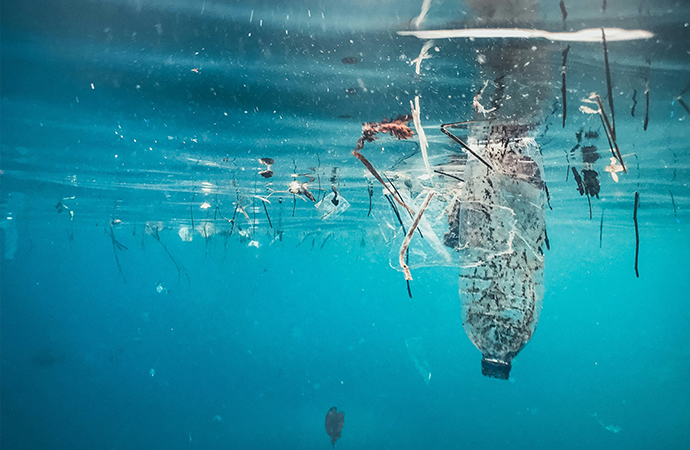 © Naja Bertolt Jensen (Unsplash)
Why focus on plastic?
I am a trained microbiologist, and at first I didn’t work on plastics at all. Seeing children playing on beaches covered with litter made me realize the link between pollution, human health, and how we perceive the environment. That visual shock brought me to focus on plastic pollution in the ocean — a material that has now become omnipresent in our lives and in the environment.
To give an idea of the scale of the problem, Sabine Roux de Bézieux, president of the Fondation de la Mer, warned: “In 60 years, the world’s population has doubled, but plastic consumption has multiplied by 40.” These numbers show just how sudden and massive the surge in plastic production and use has been. Its intrinsic qualities largely explain this overconsumption — rigidity, easy to clean, weave, sterilize, and mold. It has become indispensable in many sectors such as medicine, the textile industry, agriculture, fisheries, and food production. In this sense, plastic deserves to be understood rather than demonized. What our society has neglected is to take into account its full life cycle. For decades, humanity ignored the need to manage plastics once they became waste, at the end of their useful life.
Every year, about 400 million tons of plastic are produced worldwide. Of this production, some 20,000 tons escape into the environment each day, mostly through rivers, eventually reaching the ocean — the equivalent of two Eiffel Towers or 250 blue whales.

©Laval Ng
The plastics visible to the naked eye are called macroplastics (bottles, bags, fishing nets). Through a combination of physical, chemical, and biological processes, plastics break down into smaller pieces. If you need a magnifying glass to see them, you are looking at microplastics (between 0.3 mm and 5 mm). At the ocean’s surface, there are thought to be around 20 trillion of them. Since that number is hard to picture, I did the math: if all existing microplastics were placed end to end, they would form a necklace long enough to go to Mars and back.
And if even a magnifying glass is not enough to spot them, the plastic hasn’t disappeared — it has simply fragmented into pieces too small to be seen even with a standard microscope: these are nanoplastics. These particles are so tiny they can pass through cell membranes. They are now actively studied because they are found absolutely everywhere, including in animals, from invertebrates to vertebrates — and even in humans.
What makes plastic so problematic is also its longevity: in the ocean, plastics can persist for 100 to 1,000 years. During all this time, they continue to fragment, becoming invisible, impossible to manage, and unfortunately, ingested.

Bajos de Haina, Dominican Republic. ©Eduardo Munoz
What are the known consequences of this pollution so far?
The consequences are multiple. In the marine environment, plastic affects all living components. It is consumed by organisms of all sizes and eventually makes its way up the food chain — all the way to us.
When it comes to human health, plastics are now found in major organs of the body. Research from the past ten years shows that these particles can affect many physiological systems, with impacts on both health and behavior.
Plastic is not just waste — it is also a true vehicle. It transports and releases the additives it contains, chemical contaminants that give it color or flexibility. This represents a chemical risk for both humans and animals. Plastic can also serve as a surface for the growth of marine macro-organisms such as algae or crustaceans, but also as a host for microorganisms, forming a biofilm now referred to as the “plastisphere.” Among these microorganisms are pathogens that affect both marine animals and humans. On top of the chemical risk, there is therefore a microbiological risk, which remains largely unknown.
In your research, how do you study the plastisphere?
I am currently based in Madagascar, working within the “Indian Ocean Plastic Expedition” program, which brings together several countries (Mauritius, Seychelles, Comoros, Réunion, Madagascar) and different disciplines. To move forward in studying the microbiological risks potentially posed by the plastisphere, we are progressing step by step.
The first results confirm the presence of macro- and microplastics in the lagoons of Mauritius, Réunion, Madagascar, Seychelles, and Comoros. In Madagascar and Réunion, we found that macroplastics host on average between 135 and 27,800 times more pathogenic bacteria than the surrounding seawater. Not only are these bacteria present, but they also remain alive, even though seawater is not normally a favorable medium for them. Plastic therefore seems to help them survive better, accumulate, and in some cases, grow. We also discovered that some of these bacteria are resistant to multiple antibiotics commonly used in aquaculture and medicine, raising concerns for public health.

Translations and sources: 1: Occurence of plastics in the sea – Mattan-Moorgawa et al. 2021, Naudet et al. 2023, 2025a. 2: Microplastics carry bacteria – Sababadichetty et al. 2024, Naudet et al. 2025b, Raherimino et al. 2026. 3: Fish ingest microplastics – Naudet 2024. 4: Bacteria pass from plastic to the body – Naudet 2024, Kremer et al. in prep. Icons from flaticon.com.
Next, we assessed whether microplastics are indeed ingested by marine fauna exploited in lagoon areas. We found that 20 to 60% of the fish consumed in Mauritius contain microplastics. This raises a key question: If fish are ingesting plastics, are the bacteria living on those plastics being transferred to the fish?
We carried out experiments with the sea cucumber Holothuria scabra and the rabbitfish Siganus sutor, two species harvested in the western Indian Ocean. We used a model bacterium, fluorescent E. coli, fixed on microplastics, to track its path after ingestion. The result: In both cases, the bacteria detached from the plastic, entered the intestinal lumen, attached to intestinal walls, and then migrated through the body into major organs and edible parts.
In summary: we confirmed that microplastics are abundant in the coastal areas of Indian Ocean islands, that they host potentially pathogenic bacteria, that these bacteria are alive and able to grow, that they are antibiotic-resistant, and that they are ingested and incorporated by fish and sea cucumbers targeted by fisheries through microplastic ingestion.
The bacteria survive and migrate — but are they still infectious, and therefore dangerous, once ingested? That is our next big question!
What are the main challenges and issues in tackling this pollution?
As with many forms of environmental contamination, several scientific approaches can be activated. Some examples of solutions include:
- The use of wastewater and sewage filtration, for instance with retention barriers (grids) in small rivers and at wastewater treatment plant outlets.
- Mapping accumulation zones, made possible through imaging and oceanographic data, particularly in coastal areas, to organize targeted cleanup operations.
- Understanding and monitoring dispersion dynamics, to better anticipate the pathways and trends of this pollution.
- Studying health and environmental impacts, especially those of nanoplastics, which remain much less understood than microplastics. Taking into account socio-economic dimensions, such as tourism, fishing, and quality of life. In this context, awareness-raising and innovation are crucial, for example to develop truly biodegradable plastics.
These approaches represent necessary progress, but they remain insufficient. The real challenge lies upstream: it is not only about moving or collecting waste, but also about stopping pollution at its source.
At the international level, governance is advancing slowly. The UN treaty against plastic pollution, discussed in Korea at the end of 2024 and again in 2025, is a step forward but with mixed results: concrete decisions are slow to emerge, but at least states are talking to each other, which is positive.
Have you had the opportunity to share, popularize, and communicate your work as part of your project?
This is essential. We cannot hope to make a difference without involving society. To reach the largest audience, simply making flyers with text is not an option, as they would likely go unused. We need to design awareness actions that are adapted to the socio-cultural context in Madagascar. Therefore, we are testing other approaches. We organize conferences, meetings with decision-makers, and cultural activities such as school workshops, where children learn to measure the cleanliness of beaches. We do experiments with them, invite them to our lab, and they invite us into their classrooms. We have also invited artists, musician-authors, and comic book creators to do residencies with us on the theme of plastic pollution in the ocean, resulting in an original song recorded in a studio and broadcast on the radio, as well as comic strips, with the goal of eventually publishing a full album.
This work will continue until 2029, with many scientific, educational, and artistic partners.

Translation
This translation was done automatically from French and may contain some phrasing errors.
Sections
- Why focus on plastic?
- What are the known consequences of this pollution so far?
- In your research, how do you study the plastisphere?
- What are the main challenges and issues in tackling this pollution?
- Have you had the opportunity to share, popularize, and communicate your work as part of your project?
Other interviews
