![[Call for experts] Which practices are the most effective for biodiversity enhancement ? Your expertise is required !](https://preprod.fondationbiodiversite.fr/wp-content/uploads/2025/05/photo-certificats.jpg)
The platform Puzzling Biodiversity is OPEN !

You are an experienced ecologist currently working in the biodiversity and environment sector (academic research, private company, nature management and conservation…)? You have an opinion on biodiversity-friendly practices efficiency in forest management or agriculture in temperate climate of Western Europe ? Work out your own ranking of biodiversity-friendly practices on the Puzzling Biodiversity platform.
The Puzzling Biodiversity Platform
Puzzling Biodiversity is a platform specifically design to allow you to share your expertise. Thanks to your contribution, we will be able to test the degree of consensus between experts and attempt to publish a reference ranking of biodiversity-friendly practices in open access that could change the game in assessment tools currently available.
The platform especially design to provide the most fluid experience for users will allow you to produce quality data based on your knowledge, skills and intuition. More than just an online form to fill out Puzzling Biodiversity is built to look like a real personal work space available until the 30th of June 2025 meaning the end of this first experimentation.
It’s now your turn to act !
The most people will contribute, the stronger the results will be ! Thank you for sharing the news as widely as possible through your networks …
🔎 Find out more…
A scientific consortium composed of the Muséum national d’Histoire naturelle (MNHN) (The French National Natural History Museum), Carbone 4 and the Fondation pour la recherché sur la biodiversité (FRB) (French Biodiversity Research Foundation) launched, in early 2024, a methodological research project based on biodiversity-friendly practices certification. The assessment of the expected biodiversity gains associated with the maintenance or set-up of these practices will be achieved thanks to expert consultation and consensus building.
- Webinar : Many of you attended the webinar presenting the project and the method for assessing biodiversity gains! If you were unable to attend or would like to see it again, the video of the webinar is now online : https://youtu.be/y7ycfKzuqQc
-
Expert consultation : open to academic and non-academic experts. A particular attention will be given to quantifying the degree of consensus to the underlying assumptions of additivity of the various practices listed and the conditions of validity of associating an average gain in biodiversity with the maintenance and/or implementation of a given practice. A critical examination of the results from the statistical analysis of the data collected during the study will be carried out, including the profile of the respondents. The whole assessment process will take place on the Puzzling Biodiversity platform specifically developed for the matter. It has been specifically designed to provide an easy and fluid experience for the users.
- The wider project : The research project lead by the scientific consortium was built to achieve two main objectives :
➣ The development of an assessment methodology to test the degree of consensus between experts on expected biodiversity gains associated with the maintenance or set-up of biodiversity-friendly practices. The lists of forest management and agricultural practices used in this evaluation thanks to the Puzzling Biodiversity platform were elaborated in consultation with practitioners and academic researchers. The whole methodology as well as the reference rankings of practices that will be published at the end of the critical examination of the results could be applied to many purposes: building practices lists and elaboration of reference rankings for other sectors; utilization in projects of practices improvement; targets identification and set-up levels for plan or strategy design …
➣ The mapping of risks, opportunities and use cases associated with the set-up of a practices certification mechanism. This work led to the undermentioned publication: Publication_ Biodiversity certificates – risks and opportunities
Results from the Puzzling Biodiversity platform would supply this type of mechanism.


As part of the discussions during the Conference of the Parties on the Convention on Biological Diversity, in Colombia last November, biodiversity protection and restauration are confronted with financial issues. Furthermore, questions about effectiveness assessment of measures established to restore and maintain biodiversity in a social-ecosystem are also raised.
A scientific consortium composed of the Muséum national d’Histoire naturelle (MNHN) (The French National Natural History Museum), the Fondation pour la recherché sur la biodiversité (FRB) (French Biodiversity Research Foundation) and Carbone 4 launched, in early 2024, a methodological research project based on biodiversity-friendly practices certification. The assessment of the anticipated biodiversity gains associated with the maintenance or set-up of these practices will be achieved thanks to expert consultation and consensus building.
The scientific consortium has designed a method to assess the biodiversity gains associated with biodiversity-friendly practices. It is launching the compendium for two case studies: ‘Arable land and permanent grassland’ and ‘Utilised forests’ in Western Europe. The assessment of gains will be reached thanks to a platform developed in order to allow semi-quantitative ranking of the practices relative to each other. A large-scale expert consultation will be launched soon to validate the hypothesis that a sufficiently robust consensus exists in order to publish the first biodiversity-friendly practices’ ranking.
Temperate mixed-farming or forestry associated biodiversity is in your field of expertise?
We invite you to take part in this assessment on biodiversity gains associated with biodiversity-friendly practices.
The more people who contribute, the stronger the results will be!
Many of you attended the webinar presenting the project and the method for assessing biodiversity gains! If you were unable to attend or would like to see it again, the video of the webinar is now online.
(Re)discover the webinar
📆 See you in spring
The Puzzling Biodiversity platform, which will enable biodiversity gains associated with forestry and agricultural practices to be assessed, will open in spring 2025.

🔎 More informations about …
Experts consultation : open to academic and non-academic experts. A particular attention will be given to quantifying the degree of consensus to the underlying assumptions of additivity of the various practices listed and the conditions of validity of associating an average gain in biodiversity with the maintenance and/or implementation of a given practice. A critical analysis of the results from the statistical analysis of the data collected during the study will be carried out, including the profile of the respondents. The whole assessment process will take place on an online platform specifically developed for the matter. It has been specifically designed to provide an easy and fluid experience for the users.
The project : the scientific consortium is developing a methodology to evaluate biodiversity-friendly practices. Another part of the project is dedicated to mapping the risks, opportunities, and use cases in connection with a certification process.
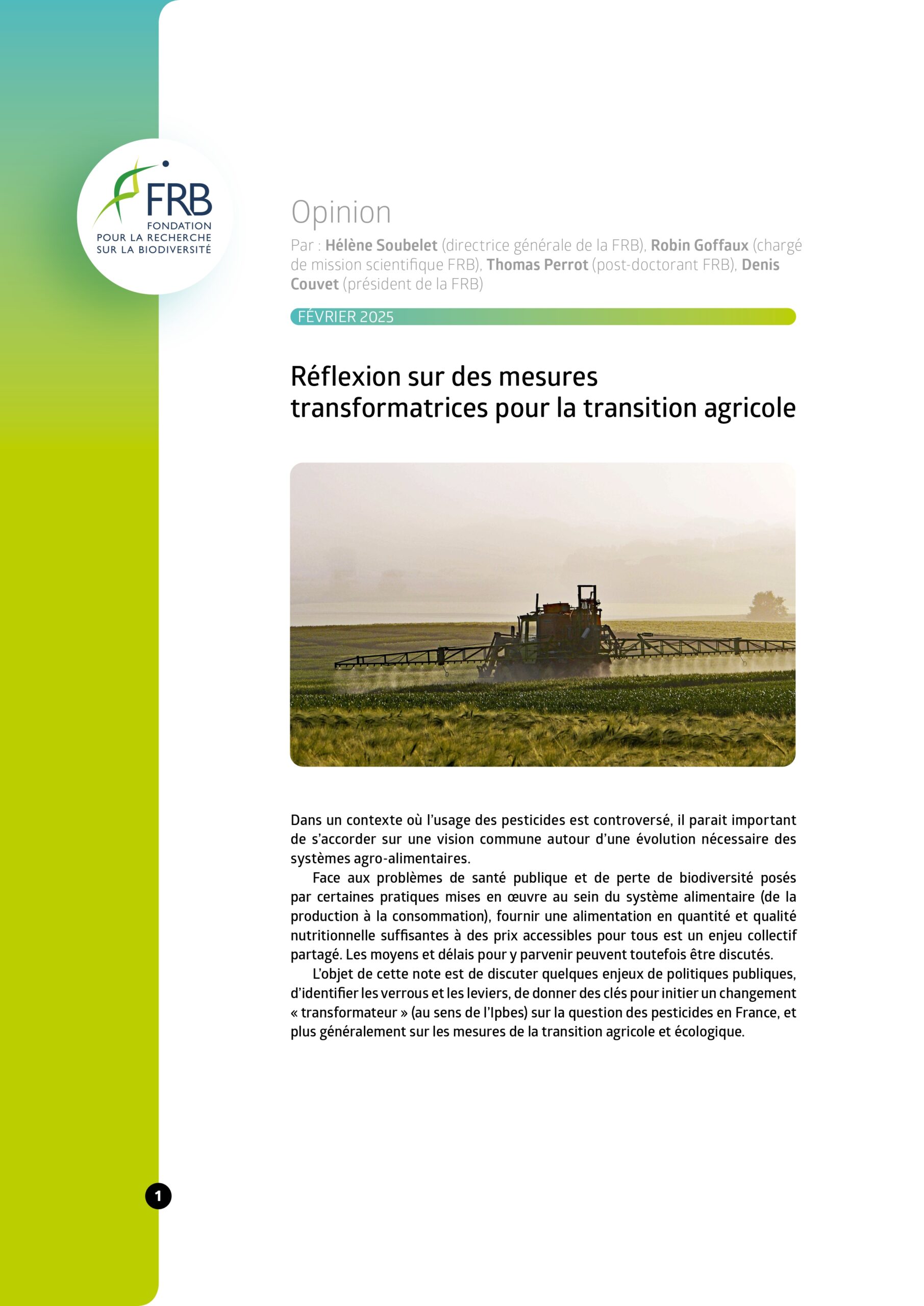
Certaines pratiques mises en œuvre au sein du système alimentaire contribuent à des problèmes de santé publique et à la perte de biodiversité. Fournir une alimentation en quantité et qualité nutritionnelle suffisantes à des prix accessibles pour tous et toutes est un enjeu collectif partagé.
L’objet de cette note est de discuter des enjeux de politiques publiques, d’identifier les verrous et les leviers, de donner des clés pour initier un « changement transformateur » sur la question des pesticides en France, et plus généralement sur les mesures de la transition agricole et écologique.
L’usage des pesticides en Europe est un des éléments d’un triptyque socio-technique composé de la culture sélective des plantes, des intrants de synthèse et de l’utilisation de machines agricoles. Ces éléments sont interdépendants : changer un élément, tel que les pesticides, est donc difficile et impliquerait un changement transformateur des différents éléments du système.
Les messages-clés
Pour pouvoir opérer ce « changement transformateur », plusieurs pistes sont creusées dans ce document :
-
Réajuster par des subventions différentiées, les prix des produits alimentaires en fonction de leurs impacts. Le prix est le principal critère d’achat des consommateurs, il est important de rétablir le juste prix de l’alimentation, intégrant les externalités comme la pollution. Cela permettrait de ne pas inciter les plus défavorisés à consommer les produits les plus riches en pesticides, impactant la santé des humains et des écosystèmes.
-
Encourager les pratiques favorables à la biodiversité, à la santé humaine et à la protection des ressources naturelles par des subvention aux pratiques vertueuses permettant de rendre la transition agricole économiquement viable. La déconnexion entre la rémunération et les impacts sur la santé et la biodiversité constitue un cercle vicieux qui diminue la résilience des agriculteurs et affecte la santé globale.
-
Ne pas considérer seulement l’indicateur rendement et réfléchir à la viabilité économique et à la résilience des exploitations utilisant la régulation biologique comme la lutte contre les ravageurs. Le risque de perte de rendement en réduisant les pesticides peut constituer un obstacle majeur au changement de pratique. Or diminuer les pesticides n’est pas toujours synonyme de baisse de rendement, mais permet toujours de réduire les charges des exploitations, avec souvent de meilleures marges brutes.
-
Mettre en place un affichage environnemental clair sur les produits alimentaires pour mieux informer les consommateurs aux impacts écologiques et sanitaires de leur alimentation, réduisant ainsi les risques d’exposition aux pesticides.
-
Préserver l’intégrité des écosystèmes dans les paysages agricoles est essentielle pour la résilience des cultures. Des incitations pour diversifier la végétation intra-parcellaire, complexifier les paysages, favoriser son intégrité écologique et sa multifonctionnalité sont indispensables.
Within the European Union (EU), agriculture is the subject of a long-standing, well-established and well-known common policy with the largest budget (386.6 billion euros for the period 2021-2027, i.e. 32% of the European budget). It is also affected by the internal market policy. In addition, various EU environmental directives apply to agricultural land. This is the case for biodiversity (Birds Directive, Habitats Directive, Environmental Liability Directive), environmental assessment (Projects Directive, Plans and Programmes Directive), water (Water Framework Directive, Nitrates Directive, Sewage Sludge Directive, Floods Directive, etc.). The EU is also party to several international conventions in the field of biodiversity that concern agricultural land (Convention on Biological Diversity, Bern Convention, Bonn Convention, Ramsar Convention, etc.).
Although European agriculture is subject to this threefold harmonization process, the rules for taxing agricultural land seem to differ quite a lot from one state to another. However, taxation affects several aspects of agricultural and environmental policies. It can encourage or discourage the profitability of agriculture, encourage the practice of a particular type of agriculture that is more or less favorable to biodiversity, and encourage or discourage a change in the use of agricultural land. Taxation of agricultural land therefore has multiple effects, both on the agricultural land itself and on agricultural, land use, urban planning and environmental policies. Moreover, within the debates on possible biodiversity policy strategies, the taxation of agricultural land and its modalities may favor one option or another.
For these different reasons, a comparative analysis of the taxation of agricultural land in Europe seemed useful to the French Foundation for Biodiversity Research.
The note is available in the downloadable resources section.
![[Press release] Study in Nature: Protecting the Ocean Delivers a Comprehensive Solution for Climate, Fishing and Biodiversity](https://preprod.fondationbiodiversite.fr/wp-content/uploads/2021/03/Photo_CP_web.png)
A new study published in the prestigious peer-reviewed scientific journal Nature today offers a combined solution to several of humanity’s most pressing challenges. It is the most comprehensive assessment to date of where strict ocean protection can contribute to a more abundant supply of healthy seafood and provide a cheap, natural solution to address climate change—in addition to protecting embattled species and habitats.
An international team of 26 authors – including researchers from Ifremer and the University of Montpellier and with the CNRS – identified specific areas that, if protected, would safeguard over 80% of the habitats for endangered marine species, and increase fishing catches by more than eight million metric tons. The study is also the first to quantify the potential release of carbon dioxide into the ocean from trawling, a widespread fishing practice—and finds that trawling is pumping hundreds of millions of tons of carbon dioxide into the ocean every year, a volume of emissions similar to those of aviation. This work was partly funded by the Foundation for Research on Biodiversity (FRB), EDF and the Total Foundation, through the FREE and PELAGIC research projects of the FRB’s Center for Biodiversity Synthesis and Analysis (CESAB).
Read the full press release
![[Call for proposals] The FRB-CESAB call on systematic reviews has been extended until the 9th of September](https://preprod.fondationbiodiversite.fr/wp-content/uploads/2020/05/aap-revue-systematique.jpg)
The FRB, through its Centre for the Synthesis and Analysis of Biodiversity (CESAB), is funding 2 postdoctoral researchers for up to 18 months, to carry out systematic reviews, using systematic mapping, critical assessment and narrative synthesis of the corpus of selected texts, in order to write a review article for an international scientific journal.
The project may go as far as either a completed lexicographical analysis or the extraction of statistical data from the corpus and their analysis (meta-analysis).
- Theme 1: State and future of marine biodiversity in a time of global change
- Theme 2, in partnership with Agropolis Fondation: Solutions for agro-ecological transition that conserve biodiversity
Pre-proposals deadline : 9th September 2020, 23:59 CEST
More information can be found on the call page.
The main findings of the report were therefore:
- To propose an appellation to replace the term “digital sequence information” with “digital data on genetic resource sequences” or “digital sequence data”;
- To define a typology following the chronology of the bioinformatics protocol for processing sequencer data outputs: raw data, cleaned data, analysed data;
- To list the main applications of this digital data.
The report was launched during a seminar that took place on Monday, 8 October, at the House of Oceans in Paris. The seminar was attended by almost 50 people with different backgrounds (representatives of ministries, diplomats, researchers, industrialists, journalists). The seminar’s meeting minutes and the speakers’ presentations are available on the FRB website.
Weeds are an important threat to crop production and management rules have been developed to regulate weeds in fields. However, intensive use of herbicides and inorganic fertilizers, large-scale simplification of crop sequences and repeated ploughing has caused considerable biodiversity loss in European agro-ecosystems; many weed species are currently threatened with extinction. Moreover, the drastic decline observed in weed diversity and abundance has highlighted the crucial functional role weeds play in agroecosystem food-webs; including in pollination, provision of habitat and biological control.
The recognition of the need to better balance food production with other, non-provisioning ecosystem services, is reflected in the 2014-2020 reform of the Common Agricultural Policy which, for the first time includes ‘greening measures’ as a requirement for Pillar 1 payments (i.e. direct income support payments to farmers) that primarily support agricultural productivity. Assuring food security and conserving farmland biodiversity while reducing chemical inputs has also been the motivation for a number of National initiatives (e.g. French Ecophyto Plan, Campaign for the Farmed Environment in the UK). In this context, it is imperative that the consequences of agricultural management on weed abundance and crop production are investigated.
The FRB-CESAB DISCO-WEED project addressed these challenges using an interdisciplinary approach and filled the knowledge gap to reducing chemical inputs and understanding the effects of weeds on crop production.
This document summarizes in a few pages the group’s context and objectives, the methods and approaches used, the main findings, as well as the impact for science, society, and both public and private decision-making.

