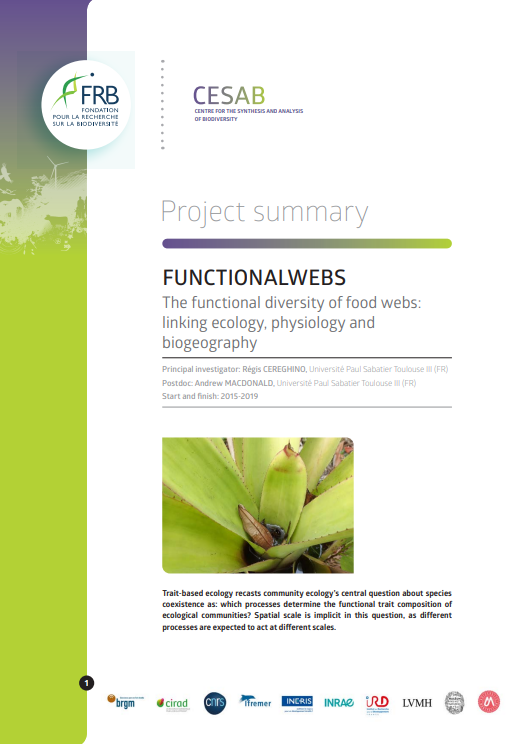
Trait-based ecology recasts community ecology’s central question about species coexistence as: which processes determine the functional trait composition of ecological communities? Spatial scale is implicit in this question, as different processes are expected to act at different scales.
Community ecology has struggled to provide predictive models that link environmental drivers with the structure of biological communities. Greater progress could be made by focussing on the functional traits of species (their physiological, biological and ecological attributes), rather than on their identities. We are specifically missing analyses of trait diversity at large spatial scales where dispersal between sites is rare, so that we cannot determine if functional diversity in general is constrained local resources or limited by dispersal, evolution, or biogeography.
The FRB-CESAB FUNCTIONALWEBS focal system (the invertebrates inhabiting water-filled bromeliad leaves) has been sampled from 22 neotropical locations, and the dataset (850 taxa; 1750 bromeliads; 12 traits; environmental variables) has been collated in an SQL database. The working group’s fundamental question was: which processes determine functional community structure at different spatial scales?
This document summarizes in a few pages the group’s context and objectives, the methods and approaches used, the main findings, as well as the impact for science, society, and both public and private decision-making.
What are the parameters that can influence the biodiversity of islands? What are the different stages of species diversification in an island environment, and what are the evolutionary processes involved? Here are some examples of questions that a team of CESAB researchers has tried to answer through the project FRB-CESAB ISLANDS.
The Equilibrium Theory of Island Biogeography (ETIB) has long served as a reference for understanding the formation of communities on islands. Based on the assumption that the number of species on an island depends on a balance between colonization and extinction processes, it predicts, in particular, that large islands or those close to continents contain more species than small or distant islands. However, although the predictions of this theory have often been verified, the size and degree of isolation are not the only factors that can influence the biodiversity of islands. Indeed, evolutionary divergence (when two groups of the same species develop different traits within these groups in order to adapt to different environmental and social pressures) and the formation of new species on the islands is a parameter that has not yet been taken into account.
Recent studies have suggested that speciation – the evolutionary process by which new species emerge – can play a role similar to colonization, adding species to communities on remote islands. Two island populations resulting from the same colonization event (the same mother population) can thus differentiate themselves within an island or archipelago and become reproductively isolated from each other; this phenomenon is called cladogenesis. But the consequent differences between speciation and colonization processes do not allow us to determine how and to what extent the analogy can be extended to the ETIB or other relevant theories that seek to explain community assembly. The initial objective of this working group was therefore to take advantage of the excellent experimental conditions of island systems to systematically examine and compare the influence of geographical and geological factors on the evolution of ecological assemblages, and then to provide a new and better understanding of the communities of species assembled over time on the islands.
This document summarizes, in just a few pages, the project’s context and objectives, the methods and approaches used, the main findings, and the implications for science, society, and both public and private decision-making.
